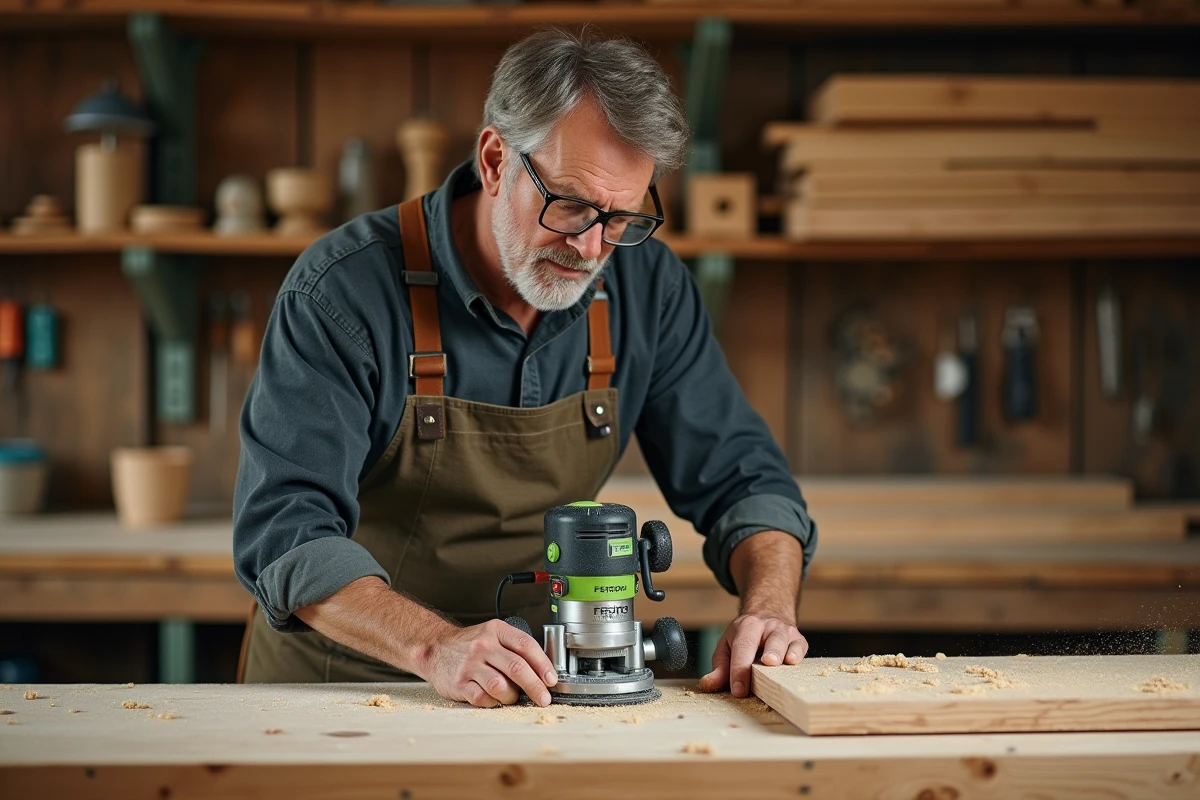
The trimmer occupies a unique place in woodworking tools. Less versatile than a router, it serves a specific role: working on edges, veneers, and small profiles with a precision that heavier machines struggle to offer. Festool positions its trimmers within an integrated system logic, where each accessory extends the capabilities of the machine. This positioning deserves to be examined beyond mere brand argumentation.
Wood Dust Collection: A Regulatory Constraint That Guides Choice
Hardwood dust is classified as carcinogenic. In 2023, the INRS updated its recommendations on occupational exposure (fact sheet ED 6169, “Wood Dust” file), increasing pressure on workshops to adopt machines compatible with effective source extraction.
Festool trimmers are designed to connect directly to the brand’s vacuum cleaners. This is not a marketing detail: native compatibility with extraction reduces exposure to fine dust during edge milling operations, often performed at face height. On an entry-level trimmer, adapting a vacuum hose is possible, but rarely optimized, leading to leaks and bulk that hinder precision.
For carpenters who regularly work with melamine panels or hardwoods (oak, beech), this aspect is no longer optional. Field feedback varies on this point: some craftsmen find the Festool extraction sufficient on its own, while others supplement it with a workshop extraction system. The configuration depends on production volume and local ventilation.
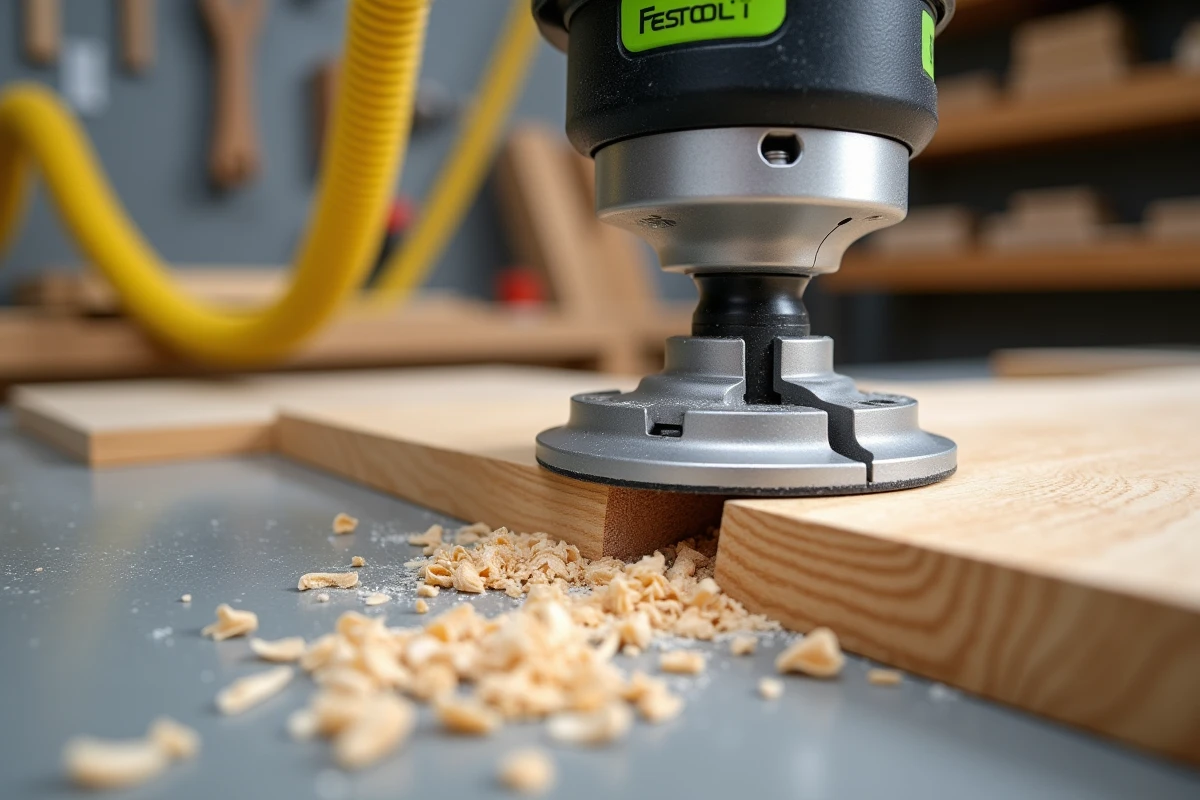
Festool Trimmer and “System” Logic: Bits, Bushings, and MFT Tables
Since 2023, Festool has expanded the accessories dedicated to its trimmers with LR32 system-compatible guide bushings, soles adapted for sensitive edges, and sets of bits optimized for coated panels. This approach, documented in the Festool 2024/2025 catalog and the “Milling Systems” brochure, remains under-detailed in the online content available.
The ability to use a Festool trimmer with a guide rail or MFT table transforms a finishing tool into a modular workstation. Milling grooves, biscuit joints, or veneer flush trimming can be done without changing machines, provided the corresponding accessories are available.
This system logic has a downside: each Festool accessory is only compatible with the Festool ecosystem. Standard shank bits work, but guide bushings, soles, and specific guides do not fit on a Makita or Bosch trimmer. The initial investment commits to the long term.
What the LR32 System Brings Practically
32 mm pitch drilling is a standard in furniture manufacturing. LR32-compatible guide bushings allow for positioning drill holes or milling with a repeatability that manual marking does not guarantee. For a carpenter producing boxes in series, even small ones, the repeatability of positioning at 32 mm pitch avoids rework.
Festool Trimmer or Router: Where is the Limit?
The confusion between trimmer and router persists because both machines use rotating bits. The difference lies in power, cutting depth, and ergonomics.
- The trimmer is lightweight, often manageable with one hand, with a limited milling depth. It excels at edges, small bevels, laminate flush trimming, and fine decorative profiles.
- The router accepts larger diameter bits, works at greater depths, and is suitable for deep grooves, wide rebates, and structural joints.
- For intermediate operations (shallow grooves in MDF, small profiles on solid edges), the two machines overlap. The choice then depends on work comfort and frequency of use.
Festool offers both categories. The trimmer does not replace the router, it complements it for tasks where the weight and bulk of a router become a hindrance. A carpenter who only occasionally trims can make do with a router set at a shallow depth. Those who edge band all day will benefit in fatigue and precision from a dedicated trimmer.
Festool vs. Makita and Bosch: What the Extra Price Funds
The price of a Festool trimmer significantly exceeds that of a Makita RT0702C or a Bosch GKF 550. The issue of the extra cost consistently arises in discussions among professionals.
Several factors explain the gap:
- Direct compatibility with the Festool ecosystem of extraction, guiding, and storage (Systainer), without adaptation or DIY.
- Availability of spare parts and the Festool repair network in France, which extends the machine’s lifespan beyond the warranty period.
- Manufacturing tolerances on soles and depth adjustment systems, which directly influence the quality of flush trimming on sensitive materials like natural wood veneer.
However, the Festool premium is only justified if the user truly utilizes the ecosystem. A Festool trimmer used alone, without a vacuum or dedicated accessories, loses part of its advantage compared to a Makita that serves the same basic function for a lower budget.

Which User Profile Benefits the Most
The artisan carpenter or installer who works on-site and in the workshop, with a regular volume of edge banding and finishing, justifies the investment. The occasional DIYer who trims two countertops a year will find sufficient alternatives with Makita or Bosch.
The Festool trimmer makes sense in a structured workflow, where extraction, guiding, and storage form a coherent whole. It is this coherence, more than the machine alone, that distinguishes the Festool offering from its direct competitors.